
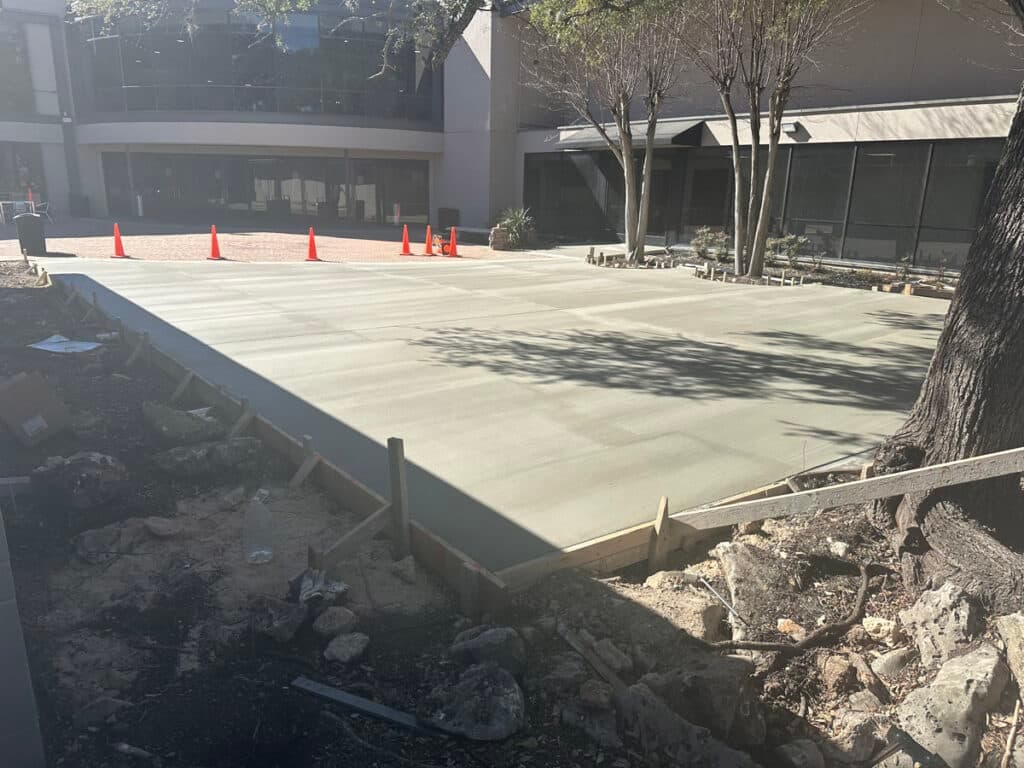
About Monolithic Slab Foundations
Monolithic slab foundations combine the building floor and perimeter footings into a single pour. This foundation type is common for smaller commercial buildings, retail structures, and some industrial applications where soil conditions permit and building loads are moderate.
The monolithic design offers construction efficiency by eliminating the separate footing pour required by other foundation systems. However, this efficiency requires careful coordination of edge beam forming, reinforcement placement, and pour sequencing to achieve the integrated structure that the design requires.
In North Texas, monolithic slabs require appropriate design for our expansive clay soils. Edge beams must extend to adequate depth, reinforcement must address expected soil movement, and proper moisture management below the slab prevents differential movement that cracks foundations.
Our monolithic foundation work serves commercial buildings where the foundation type is appropriate. We evaluate soil conditions, building loads, and project requirements to ensure monolithic construction is the right choice, or recommend alternative systems when conditions require them.
What’s Included
- Site preparation and excavation
- Subgrade compaction and verification
- Vapor barrier installation
- Edge beam forming
- Reinforcement installation
- Below-slab utility coordination
- Continuous concrete placement
- Finishing to specified tolerances
- Curing and protection
Frequently Asked Questions
When is a monolithic slab appropriate for commercial construction?
Monolithic slabs work well for smaller commercial buildings, single-story retail, and light industrial buildings on suitable soil. Buildings with heavy loads, multi-story construction, or particularly expansive soils typically require post-tension or pier-and-beam foundations.
How does a monolithic slab differ from post-tension?
Monolithic slabs use conventional reinforcement without the cables and stressing required for post-tension. They are simpler to construct but may not provide the same resistance to soil movement on highly expansive clay. The appropriate choice depends on soil conditions and building requirements.
What soil preparation is required for monolithic slabs?
Proper soil preparation includes removal of organic material, moisture conditioning of subgrade, and compaction to specified density. In North Texas, we often recommend lime stabilization or other soil treatment for highly plastic clays.
How deep are the edge beams on monolithic slabs?
Edge beam depth depends on soil conditions and structural requirements, typically ranging from 12-24 inches. Deeper beams provide better resistance to soil movement but require more excavation. The structural engineer specifies beam depth based on soil and loading conditions.
What thickness is typical for the interior slab?
Interior slab thickness is typically 4-6 inches depending on expected floor loads. Areas with heavy rack storage or equipment may need thicker slabs. The structural engineer specifies thickness based on loading requirements.